
Real recordings · Lifetime license · Music you can own
Christmas Music for Video
Almost every classic carol is public domain as a composition — Silent Night (1818), O Christmas Tree (1824), Jingle Bells (1857). What your video still needs is the right to a specific recording, because every recording stays protected. That is what you license here: real performances by real choirs and brass ensembles, €29.90 once per track, worldwide and for life, with a licence certificate as documented proof.
Curated by Paul Lorenz — composer, arranger & conductor · London Symphony Orchestra · Abbey Road Studios · Vienna State Opera
500M+ streams · Gold & Double Platinum · Instant download · Lifetime worldwide license
Is Christmas music copyright free — and do you actually need it to be?
The phrase covers two completely different situations with different answers. What matters is not whether music is “free”, but what you are using it for. Here is honestly what we cover — and what we do not.
| Your use | What actually applies |
|---|---|
| YouTube video, Reel, TikTok, social postHoliday clip, year-in-review, greeting videoCovered | Fully covered. Sync and master rights come directly from Artyfile — no additional collection-society fee on your licence. Our catalog is registered in YouTube Content ID with a monetize policy: a Content ID claim may appear, but your video is subject to YouTube Content ID rules. |
| Commercial, brand film, client videoHoliday campaign, agency productionCovered | Fully covered — worldwide and permanent, with no regional tiers and no renewals. Your licence includes a certificate as documented proof of rights for clients, broadcasters and E&O review. |
| Online shop, website, newsletter videoHoliday promotion, product videoCovered | Fully covered. €29.90 once per track, no subscription, no re-licensing next December. |
| Film, series, broadcastChristmas episode, TV airingCovered | You buy the synchronisation rights a production needs — worldwide and unlimited in time. The broadcaster settles its own performance royalties under its blanket agreement, exactly as with any music. |
| Christmas market, shop, restaurantMusic played publicly to an audienceNot our case | Honestly, we are not the right product here. Public performance is — for ANY music — a separate matter between the operator and the local collection society (GEMA in Germany, PRS, ASCAP/BMI elsewhere). Artyfile music is in the GEMA repertoire, like the work of every professional composer. If your only goal is to avoid registering a public performance, you need a provider with expressly society-free repertoire, not us. |
| Live event, company party, church servicePerformance to an audienceNot our case | Same answer: the organiser reports the performance as usual. Our licence covers use in recordings and video, not public performance. |
| Video OF the event, posted afterwardsChristmas market aftermovieCovered | That is case 1 again, and fully covered: the moment it is a video, your sync licence applies. Only the music played live on site remains the organiser’s matter. |
The real question is not “is it free?” but “am I allowed to use this recording in my video?”
For video, advertising, social and film the Artyfile answer is yes — €29.90 once, worldwide, for life, with a certificate. Because we administer sync and master rights ourselves, no additional collection-society fee lands on your licence.
The short answer: the carol is free, the recording is not
The most common and most expensive Christmas mistake goes like this: “Silent Night is 200 years old, so I can use it.” The first half is true. Franz Xaver Gruber died in 1863, so the composition is unambiguously public domain — as are O Christmas Tree, The First Noel, Deck the Halls, Good King Wenceslas and Jingle Bells. You may freely re-arrange those melodies and record them yourself.
What you may not do is drop an existing recording of them into your video. Every individual performance is its own protected work — the one on YouTube, the one on Spotify, the one in a free-download folder, and ours. Nearly every Christmas Content ID claim video makers collect in December starts exactly here: the song was free, the recording never was.
An Artyfile licence solves precisely that. You get the recording, the sync and master rights that go with it, and a certificate you can show a client or a broadcaster — €29.90 once, no subscription, no re-licensing next December.
Who actually performs this Christmas music?
This is the difference from most of this category, and you can hear it. Our Christmas recordings do not come from a synthesizer or an AI model, but from real ensembles with names and a home:
- Tuxer Kirchenchor — Silent Night, sung by an actual Tyrolean church choir in the Zillertal valley.
- Bläserkreis Hippach — a genuine Alpine brass ensemble on the traditional German carols.
- Männerchor Hippach — the Glockenjodler, sung the way it is actually sung there.
- Paul Lorenz — composer and arranger with over 500 million streams, behind the orchestral carol arrangements and a jazz version of Jingle Bells.
If your Christmas production needs to feel real, a genuine church choir is a fundamentally different thing from a simulated choir patch. That is why these recordings exist.
What the licence costs and what it covers
Artyfile Basic — €29.90 once per track. A worldwide, lifetime synchronisation and master-use licence. Valid for YouTube, Instagram, TikTok, commercials, brand films, short films, client work and broadcast. No subscription, no regional tiers, no renewals. The 44.1 kHz WAV download and your licence certificate are available the moment you buy.
Artyfile Limited Edition — from €69.90 for 1% of the master. If you want to own a Christmas title rather than only use it, you can buy numbered shares in the master, entered in the Artyfile ownership register. As a co-owner you receive a proportional bonus from the streaming and sync income that title generates. That bonus is honestly not guaranteed and can be zero — though Christmas repertoire does have the useful habit of coming back every single year.
Christmas music on YouTube: the honest position
Our catalog is registered in YouTube Content ID with a monetize policy, like the catalog of every professional rights holder. In practice that means a Content ID claim may appear in your YouTube Studio. What cannot happen: a block, a mute, a strike or a takedown. That is exactly what your licence and certificate are for.
Anyone promising you that no claim will ever appear on Christmas music is explaining the system wrong. The distinction that matters is between a claim and a block.
Christmas markets, shops and live events — not our product
A large share of Christmas music searches come from people who want to play music publicly: at a market stall, in a shop, in a restaurant, at a company party. We will say plainly that we do not solve that. Public performance is — for any music — a separate matter between the operator and the local collection society (GEMA in Germany, PRS, ASCAP or BMI elsewhere). Artyfile music sits in that repertoire, like the work of every professional composer.
So if your only goal is to avoid registering a public performance, you need a provider with expressly society-free repertoire. If your goal is to use Christmas music safely in a video, an ad or a film, this is exactly the right place — and no additional collection-society fee lands on your licence, because we administer sync and master rights ourselves.
Which Christmas songs are public domain — and what does that mean for your video?
Short answer: almost every classic carol is public domain as a composition. That still does not let you use just any recording of it. This table shows, for every carol we have actually recorded, how old the composition is, who wrote it — and who performed it for us.
| Carol | Written by | Public domain since | The Artyfile recording |
|---|---|---|---|
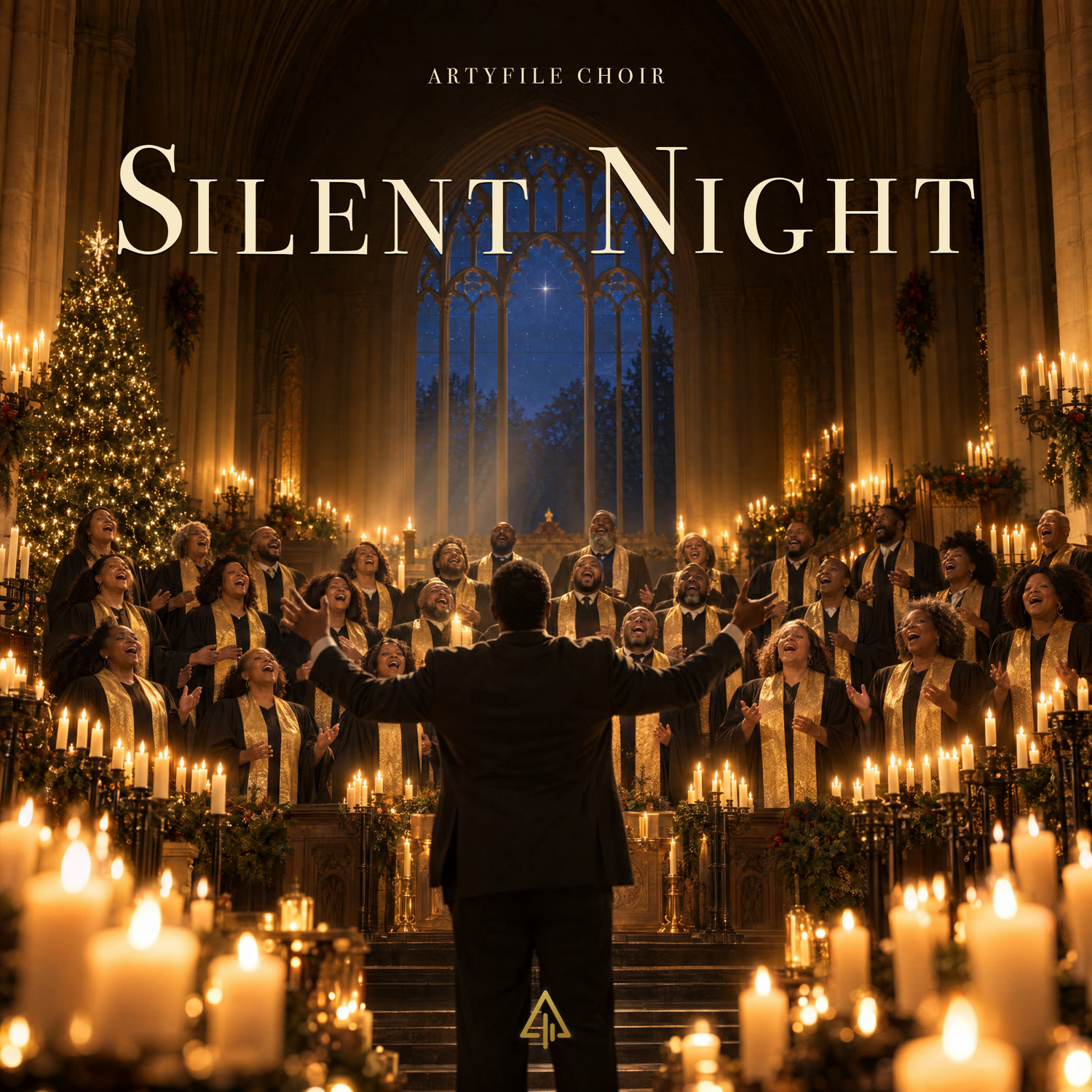
| Silent Night | Franz Xaver Gruber / Joseph Mohr | 1818 | Tuxer Kirchenchor (Tyrolean church choir) |
| The First Noel | traditional English | trad., pub. 1823 | Artyfile orchestral |
| Deck the Halls | traditional Welsh | trad., pub. 1862 | Artyfile orchestral |
| Good King Wenceslas | John Mason Neale | 1853 | Artyfile orchestral |
| We Wish You a Merry Christmas | traditional English | trad., 16th c. | Artyfile orchestral |
| Jingle Bells | James Lord Pierpont | 1857 | Paul Lorenz (also a jazz version) |
| O Christmas Tree (O Tannenbaum) | Ernst Anschütz | 1824 | Paul Lorenz |
| Lo, How a Rose E’er Blooming | trad., setting by Michael Praetorius | 1599 | Paul Lorenz |
| O How Joyfully (O du fröhliche) | Johannes Daniel Falk | 1816 | Bläserkreis Hippach (Tyrolean brass) |
| Vivaldi — Winter (The Four Seasons) | Antonio Vivaldi | 1725 | Artyfile Orchestra |
The composition is free.
For every work above, the composer and lyricist died well over 70 years ago (and each was published long before 1930). The composition itself is public domain — you may re-arrange it, record it yourself, and use it freely.
The recording never is.
Every individual performance is its own protected work — that is equally true of a YouTube rip, a Spotify track, a free download and ours. This is where nearly every Christmas Content ID claim comes from: the song was free, the recording was not. At Artyfile you licence the recording — €29.90 once, worldwide, for life, with a licence certificate as documented proof.
One honest exception: “Advent ist ein Leuchten” (Lorenz Maierhofer) is a modern composition and expressly NOT public domain — which is why it is not in this table.
Why Artyfile
Real choirs and brass bands
Silent Night by the Tuxer Kirchenchor, O du fröhliche by Bläserkreis Hippach, Glockenjodler by Männerchor Hippach — real ensembles, never AI, never a synth library.
The carol is free, the recording is not
Almost every Christmas carol is public domain as a composition — every recording of it stays protected. That recording is what you licence here, with a certificate as proof.
€29.90 once, yours for good
Worldwide sync and master licence, for life. No additional collection-society fee on your licence, no subscription, no re-licensing next December.
Instant download
Studio-grade 44.1 kHz WAV plus a licence certificate, the moment you buy.
Christmas Music for Video: hand-picked & sync-ready



Bach/Gounod: Ave Maria Recomposed (Violin Version)
Bach/Gounod

Frequently asked questions
Is Christmas music copyright free?
Partly — and the distinction is what matters. The classic carols are public domain as compositions: Silent Night (1818), O Christmas Tree (1824), Jingle Bells (1857), The First Noel, Deck the Halls. But every recording of those carols is a separate protected work that still needs a licence. So “the song is free” and “this audio file is free to use” are two completely different statements. Artyfile licenses you the recording — €29.90 once, worldwide, for life.
Are Christmas songs in the public domain?
Almost all the traditional ones are. Silent Night (1818), O Christmas Tree (1824), Good King Wenceslas (1853), Jingle Bells (1857), The First Noel, Deck the Halls, We Wish You a Merry Christmas and Lo, How a Rose E’er Blooming (1599) are all long out of copyright — their composers died well over 70 years ago, and every one was published before 1930. Modern Christmas songs are firmly protected, and so is every specific recording of an old carol.
Can I use Christmas music in a YouTube video?
With a licence, yes. Without one, no — even for a 200-year-old carol, because the recording you are using is protected regardless of the age of the song. An Artyfile licence at €29.90 covers YouTube, Instagram, TikTok and commercials, worldwide and for life. Our catalog is registered in Content ID with a monetize policy, so a claim may appear, but your video is subject to YouTube Content ID rules.
What does a Christmas music licence cost?
€29.90 once per track. That covers a worldwide, lifetime sync and master-use licence, the 44.1 kHz WAV download and a licence certificate as documented proof of rights. There is no subscription, no regional tier and no renewal next December. If you would rather own part of the recording, Limited Edition starts at €69.90 per 1% of the master.
Can I use free Christmas music for a commercial video?
Usually not safely. Free Christmas tracks tend to carry one of four catches: the licence is personal-use only and excludes commercial work; it requires attribution you will forget in the edit; it is valid on one platform only; or it is simply a protected recording of a public-domain carol being passed around as free. On a client project or an ad, that mistake costs far more than the €29.90 a clean licence would have.
Who performs Artyfile's Christmas music?
Named, real ensembles. The Tuxer Kirchenchor — a Tyrolean church choir — sings Silent Night; the Bläserkreis Hippach, an Alpine brass ensemble, plays the traditional German carols; the Männerchor Hippach sings the Glockenjodler. The orchestral carol arrangements and a jazz version of Jingle Bells come from composer and arranger Paul Lorenz. No AI generation, no synth library — with Christmas music that difference is immediately audible.
Do I need a licence for a public-domain carol if I record it myself?
No. If the composition is public domain and you perform and record it yourself, you own that recording and owe nobody a sync fee. The reason most people license instead is simple: recording a real choir or brass ensemble properly costs far more than €29.90. What you cannot do is take somebody else's recording of the same public-domain carol and treat it as free.
Can I use this Christmas music at a Christmas market or in my shop?
That is a different question with a different answer, and we will be straight about it: public performance is handled separately by the venue or operator with the local collection society, for any music including ours. Our licence covers use in videos, films and ads — not public playback. If avoiding a public-performance registration is your only goal, you need a provider with expressly society-free repertoire rather than us.