
Licensing
8 Music Copyright Myths Video Creators Still Believe
Credit, 30 seconds, fair use, non-commercial, iTunes: eight music copyright myths that get videos claimed, and what US and EU rules actually say.
By Paul Lorenz · · Updated · 9 min read
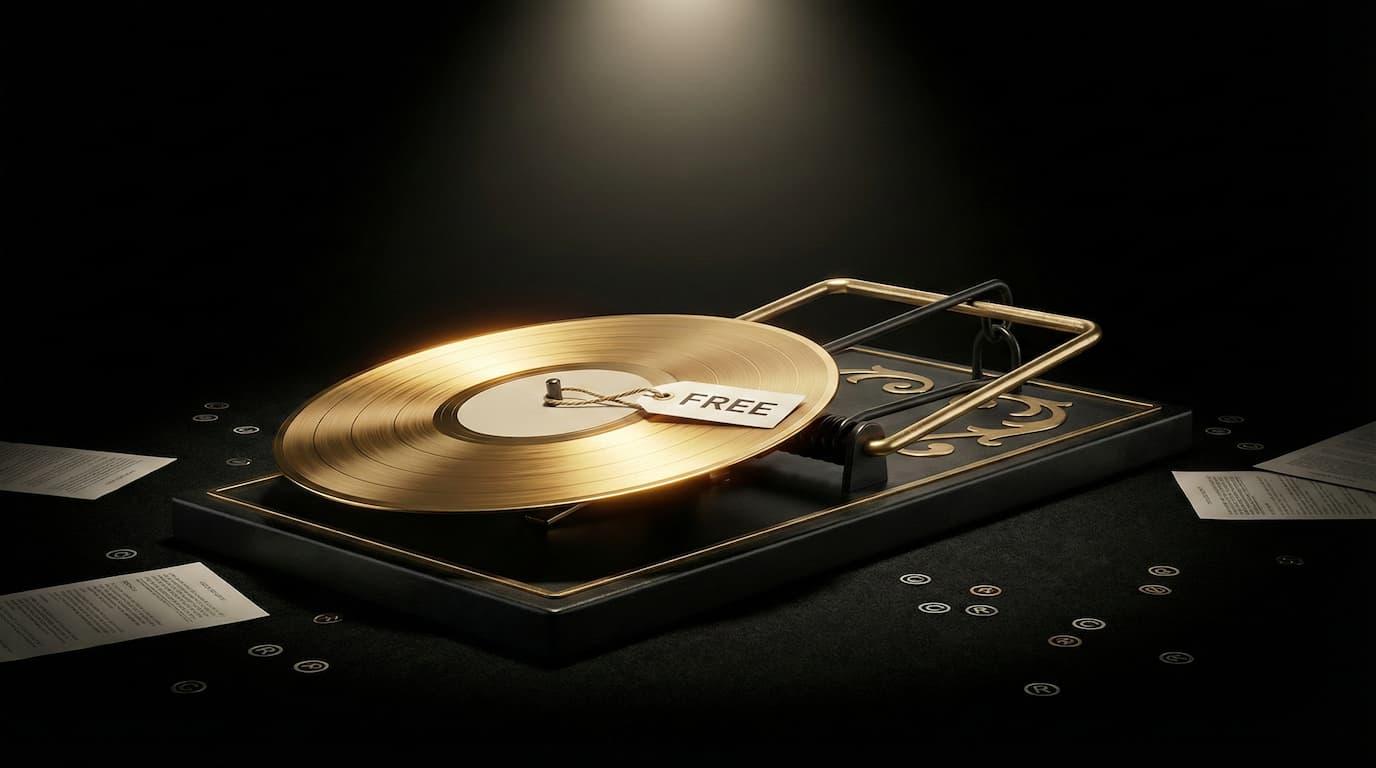
Most music problems in video do not start with bad intent. They start with a rule of thumb someone heard once and never checked. Here are the eight we see most often, and what the official sources actually say.
This article explains general rules in the US and in Germany/EU. It is not legal advice; for a specific dispute, speak to a lawyer in your jurisdiction.
Myth 1: Is giving credit enough to use a song?
No. Credit is not permission. Writing "music by…" in the description tells viewers who made the song; it does not grant you any rights. YouTube's dispute guidance lists "giving credit to the copyright holder" as a reason that does not count. Credit becomes a legal duty only when a licence requires it, for example every standard Creative Commons licence (they all include BY). Even then, credit is one condition of the licence, not a substitute for it.
Myth 2: Is it fine to use a song if the clip is under 30 seconds?
There is no safe number of seconds. The U.S. Copyright Office puts it plainly: there is no formula that guarantees a predetermined amount of a work may be used without permission. The amount is one factor in a fair use analysis, and a short but recognisable hook can weigh heavily. Content ID, meanwhile, is built to match short segments.
Germany adds a nuance that often gets misquoted. Under §§ 9 and 10 of the Copyright Service Provider Act (UrhDaG), uses of up to 15 seconds of a sound track can be presumed permitted on upload platforms, but only if the upload uses less than half of the work, combines it with other content and serves non-commercial purposes or earns only insignificant revenue. It is a rule for keeping content online during a platform dispute, not a general licence, and it does not apply to your client video, your ad or your website.
Myth 3: Does fair use cover background music in my videos?
Rarely, and only in the US. Fair use is a US doctrine that courts weigh on four factors: the purpose and character of the use (transformative uses weigh more), the nature of the work, the amount used and the effect on the market for the original. Music added to set a mood is usually not transformative: it does the same job the song was written to do, which is exactly the market a licence serves.
Outside the US there is no general fair use. Germany and the EU work with a closed list of exceptions. The quotation right in § 51 UrhG requires that the use is justified by its specific purpose, typically engaging with the quoted work, such as a review that discusses the song. Caricature, parody and pastiche (§ 51a UrhG) need an artistic engagement with the original. A vlog soundtrack fits neither.
Myth 4: If my video is non-commercial, can I use any music?
No. Copyright applies whether or not you earn money. Non-commercial purpose is one element in a US fair use analysis, not an exemption. In Germany, § 97a UrhG limits the recoverable lawyer's fees for a first warning letter (Abmahnung) against a private person acting outside business or self-employment, by calculating them on a value of €1,000. That lowers the cost of a mistake but still treats it as one. On YouTube, choosing not to monetize is listed as an invalid reason to dispute a claim. And many channels that start "non-commercial" add sponsors later, at which point the old videos are commercial too.
Myth 5: I bought the song on iTunes, so can I use it?
No. A purchase or a streaming subscription is a licence to listen, not to publish. Apple's Media Services Terms state that content may be used only for personal, noncommercial purposes; streaming services have equivalent terms. Putting a song into a video that others watch needs two further rights: the right to synchronise the composition to picture and the right to use that specific recording (the master). Neither comes with a consumer purchase.
Myth 6: Is a recording of a public domain composition free to use?
The composition is free, the recording usually is not. Beethoven, Mozart and Bach are public domain. The orchestra that recorded the symphony last year, and the label that released it, have their own rights in that recording. In the EU those last 70 years after publication, so a recording released in 2019 is protected until the end of 2089. We cover the details in royalty-free vs copyright-free vs public domain and, for classical repertoire, in free classical music for videos.
Myth 7: Does the YouTube Audio Library cover every use?
It covers what YouTube says it covers, and some tracks come with conditions. YouTube describes Audio Library music as copyright-safe for use in your videos. Some tracks are under Creative Commons and require you to credit the artist in the description; others use the standard Audio Library licence. YouTube also makes clear it only vouches for music from its own library, not for royalty-free music from other sources. If you plan to use a track outside YouTube, in client work or in paid ads on other platforms, read that track's licence first rather than assuming.
Myth 8: Does a Content ID claim mean I did something illegal?
No. A claim is an automated match, not a verdict. Rights holders register reference files, and YouTube flags every upload that contains them. Licensed music gets claimed too, for example when the licensor registers its own catalog. A claim affects one video and usually leaves the channel alone; a copyright strike follows a legal removal request and counts against the channel.
Artyfile, for example, registers its catalog in Content ID with a monetize policy. A claim may appear on a video that uses a licensed Artyfile track; it is not a copyright strike. With Basic the ad revenue claimed for the music goes to Artyfile, and with Limited Edition you share in the recording's worldwide Content ID revenue. What to do with a claim, step by step, is in Content ID claim on music you licensed.
What actually makes music safe to use in a video?
One licence that covers the composition and the recording, for the use you have in mind, with a document you can show. A quick checklist:
| Question | Why it matters |
|---|---|
| Does the licence cover sync (composition) and master (recording)? | A video needs both |
| Does it name your use: own channel, client work, ads, broadcast? | Scope is where most licences are narrower than expected |
| Is it worldwide and time-unlimited, or tied to a subscription? | Subscription rights can end when you stop paying |
| Do you get a certificate and invoice? | Proof resolves claims and letters quickly |
| What does the provider do in Content ID? | Tells you whether a claim will appear and who earns from it |
| Who handles public playback? | Shops, venues and events need their own collecting-society licence |
Artyfile Basic answers those questions in one line: €29.90 once per track, sync and master together, worldwide and in perpetuity, for your own and your clients' projects, with a PDF certificate. Public playback in venues remains the operator's matter with the local collecting society. More on the licence model in our sync licensing overview, and on channel safety in how to avoid copyright strikes on YouTube.
Bottom line
Credit, short clips, non-commercial intent and a purchased copy all feel like they should count, and none of them licenses a video. Fair use is narrower than its reputation and does not travel outside the US. The reliable route is dull and cheap: license the recording for your use and keep the proof.
Frequently asked questions
Is it legal to use music in a video if I give credit to the artist?+
Not by itself. Credit is not permission. YouTube explicitly lists giving credit to the rights holder as an invalid reason to dispute a copyright claim. Credit only matters when a licence requires it, for example a Creative Commons licence.
Can I use 30 seconds of a song without permission?+
There is no safe number of seconds. The U.S. Copyright Office states that no formula guarantees a predetermined amount of a work may be used without permission, and Content ID can match short segments. Germany has a narrow platform rule for uses up to 15 seconds, but it is a temporary presumption in platform disputes, not a general permission.
Does fair use apply to background music in my videos?+
Fair use is a US doctrine decided case by case on four factors, and background music used for mood rarely fits it. The EU and Germany have no general fair use; they have narrow exceptions such as quotation (§ 51 UrhG) and caricature, parody and pastiche (§ 51a UrhG).
If my video is non-commercial, can I use any music?+
No. Copyright applies whether or not you earn money. Non-commercial purpose can weigh in a US fair use analysis and, in Germany, it limits recoverable lawyer's fees for private first-time infringers, but it does not turn an unlicensed use into a licensed one. Not monetizing is also not a valid reason to dispute a YouTube claim.
I bought the song on iTunes or Spotify. Can I use it in my video?+
No. A consumer purchase or subscription is a licence for personal listening. Apple's Media Services Terms say content may be used only for personal, noncommercial purposes. Putting it in a published video needs sync and master rights.
Is a public domain composition free to use in any recording?+
The composition is free, the recording is not. Recordings carry their own rights for the label and performers, in the EU for 70 years after publication. You need a licensed recording or your own performance.
Does a Content ID claim mean I broke the law?+
No. A claim is an automated match against a registered reference file. It can appear on licensed music too, for example when the licensor registers its catalog with a monetize policy, as Artyfile does. A claim is not a copyright strike.